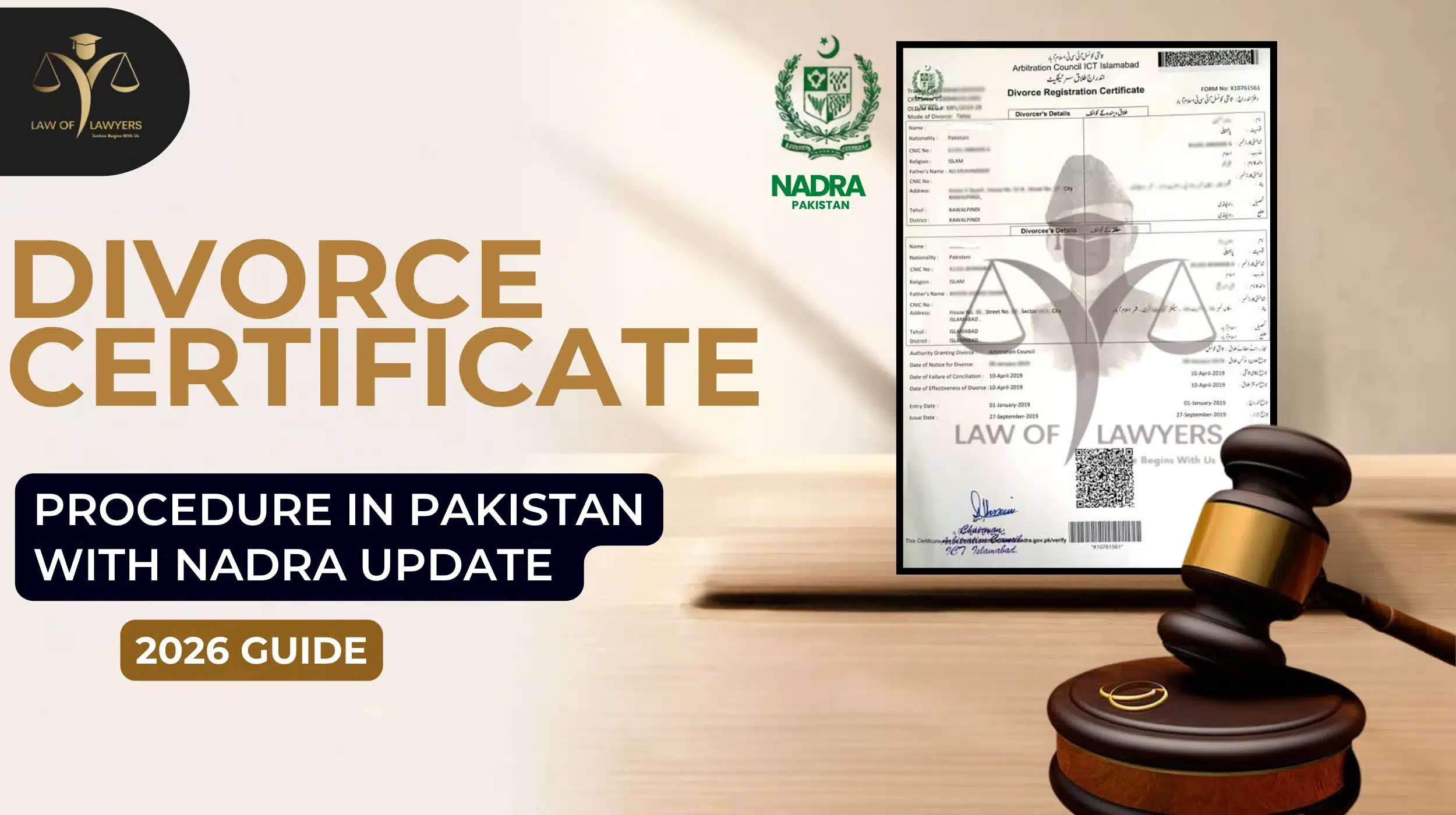
Online Divorce Certificate Procedure in Pakistan with NADRA Update
Divorce in Pakistan involves legal procedures, official documentation, and registration with the relevant authorities. Pronouncing talaq or obtaining a Khula decree does not automatically mean that every government record has been updated. The applicable legal process must be completed, and the relevant divorce record must be registered before applying for changes to NADRA records.
The online divorce procedure in Pakistan with NADRA update can help Pakistani citizens, particularly overseas Pakistanis, manage many parts of the process remotely through a lawyer or authorized representative. Depending on the case, this may include preparing documents, submitting notices, handling Union Council proceedings, obtaining a Divorce Registration Certificate, and requesting a marital-status update.
This guide explains the divorce procedure in Pakistan, the documents generally required, the 90-day reconciliation period, and the steps involved in updating your NADRA record.
What Is the Online Divorce Procedure in Pakistan?
Online divorce generally refers to managing divorce-related legal work remotely rather than travelling to Pakistan for every step. It does not mean that all legal requirements can be skipped or that every divorce can be completed entirely online.
Depending on the type of divorce and the relevant authority’s requirements, remote legal assistance may cover:
- Online consultation with a family lawyer
- Preparation of divorce notices, petitions, affidavits, and supporting documents
- Special Power of Attorney (SPA) arrangements for overseas Pakistanis, where appropriate
- Submission of documents to the relevant Union Council or Family Court
- Follow-ups during the reconciliation and registration process
- Assistance in obtaining the official Divorce Registration Certificate
- Guidance on updating NADRA marital status and the Family Registration Certificate (FRC)
The procedure depends on whether the case involves talaq, delegated divorce, or Khula through the Family Court. The applicable provincial rules and the relevant authority’s requirements must also be considered.
Why Is Online Divorce and NADRA Record Update Important in 2026?
Many Pakistani citizens live abroad or in cities far from the authority handling their divorce registration. Managing documents and official proceedings from a distance can be difficult without proper guidance.
An organized legal process can help with:
- Overseas Pakistanis: Managing divorce documentation while living in the UK, USA, Canada, UAE, or another country.
- Official registration: Completing the required Union Council or other applicable registration process.
- NADRA records: Requesting an update to marital status after completing the relevant legal formalities.
- Family Registration Certificate: Correcting family records where an update is required and permitted.
- Future legal matters: Maintaining consistent records for remarriage, immigration applications, and other matters where proof of marital status is needed.
It is important to distinguish between legal effectiveness of a divorce and an update to NADRA’s database. NADRA record modification is an administrative step; it does not, by itself, determine whether a divorce is legally effective.
Types of Divorce Recognized Under Pakistani Law
Before starting the online divorce procedure, it is important to identify the legal route that applies to your situation.
1. Talaq by the Husband
Under Section 7 of the Muslim Family Laws Ordinance, 1961, a husband who pronounces talaq must provide written notice to the Chairman of the relevant Union Council and supply a copy to his wife.
The statutory procedure generally includes:
- Preparing and submitting the written notice.
- Providing a copy of the notice to the wife.
- Union Council proceedings and an attempt at reconciliation.
- Completion of the applicable statutory period.
- Obtaining the relevant divorce registration or effectiveness certificate from the competent authority.
Under Section 7, talaq ordinarily does not become effective until 90 days have expired from the date the notice is delivered to the Chairman, unless it is revoked earlier. If the wife is pregnant at the time of pronouncement, the statutory provision may extend the effective date until the later of the applicable period or the end of pregnancy.
The exact requirements should be checked against the facts of the case and applicable law.
2. Khula Through the Family Court
Khula is a form of dissolution of marriage that a wife may seek through the Family Court. The process generally involves filing a suit, serving notice on the husband, completing the court proceedings, and obtaining a decree.
After the decree, the statutory process for forwarding it to the relevant Chairman and completing the applicable registration formalities must be followed. Under Section 21B of the Family Courts Act, a certified copy of a dissolution decree is to be sent to the relevant Chairman, who then proceeds under the applicable legal framework.
A Khula decree and the subsequent registration process serve different purposes. The documents required to update NADRA should be confirmed with the relevant authority.
3. Delegated Right of Divorce
A wife may be able to exercise a delegated right of divorce if that right was granted in the Nikahnama or marriage contract. The relevant provision is often associated with Column 18 of the Nikahnama.
The wording of the marriage contract and the circumstances of the case should be reviewed by a family lawyer before deciding whether the delegated-divorce procedure applies.
Online Divorce Procedure in Pakistan: Step by Step
The steps below explain the general process. The precise procedure may differ depending on the type of divorce, location, and relevant authority.
Step 1: Review the Case and Prepare the Documents
The first step is to identify the appropriate legal procedure and gather the necessary documents. A family lawyer can review the Nikahnama, identity documents, and relevant details before preparing the notice or petition.
Depending on the case, the documents may include:
- Husband’s and wife’s CNIC or NICOP copies, where available
- Copy of the Nikahnama or marriage registration record
- Passport copies for overseas parties, where required
- Written talaq notice or Khula petition
- Family Court decree, where applicable
- Special Power of Attorney and supporting attestations, if representation is being arranged from abroad
- Any additional documents requested by the relevant authority
Not every case requires every document on this list. Confirm the requirements with the relevant Union Council, court, or registration authority before submission.
Step 2: Submit the Talaq Notice or Initiate Court Proceedings
For a talaq case, the written notice must be delivered to the Chairman of the relevant Union Council, with a copy supplied to the wife as required by law.
The relevant Union Council is generally determined by the applicable jurisdictional rules, including the wife’s residence at the time of pronouncement under the West Pakistan Rules under the Muslim Family Laws Ordinance, 1961.
For a Khula case, the wife generally begins by filing a suit in the Family Court with jurisdiction. The court manages the proceedings and, following a decree of dissolution, the decree is forwarded to the relevant authority in accordance with the law.
Read more about our online divorce services in Pakistan.
Step 3: Complete Union Council Proceedings and the Reconciliation Period
In a talaq case, the Chairman is required under Section 7 to constitute an Arbitration Council within 30 days of receiving the notice to attempt reconciliation between the parties.
The ordinary 90-day statutory period is calculated from the date the notice is delivered to the Chairman—not simply from the date the talaq was pronounced. The law also contains a specific provision concerning pregnancy.
For a court-ordered dissolution, the relevant authority follows the applicable statutory process after receiving the decree. The procedure should not be assumed to be identical in every type of case.
Keeping proof of submission and receipt is important because it can help establish when the relevant statutory process began.
Step 4: Obtain the Divorce Registration Certificate
After the applicable legal and administrative process has been completed, the relevant authority can issue the appropriate divorce registration or effectiveness certificate.
Check the certificate carefully for spelling mistakes, incorrect identity details, and inconsistencies in the marriage record. Errors may create difficulties when the document is used for NADRA record modification or for official purposes abroad.
You can learn more about the Divorce Certificate in Pakistan and the applicable documentation process.
Step 5: Apply for the NADRA Marital Status Update
Once the required divorce documentation is available, the next step is to request an update to the relevant NADRA record.
Depending on the case and current NADRA requirements, this may involve:
- Obtaining the official divorce registration document.
- Preparing the required CNIC, NICOP, and supporting records.
- Applying through an available NADRA service channel, such as a Registration Center or the PakID mobile application where the service is supported.
- Completing any required identity verification or biometric checks.
- Responding to any requests for additional documents.
- Checking the updated marital-status record and requesting any necessary correction to the FRC.
The available application method and supporting-document requirements can vary. A divorce certificate does not guarantee that every record will be updated automatically; NADRA must process the relevant request under its applicable rules.